What's in a Name?
17

One of the quirks of UK-style cryptic crosswords is that setters, when they are credited, normally use pseudonyms rather than their given names. On the rare occasions that crossword setters get together in person, one topic of conversation is quite often "So, where did you get that name from?"
When I first met our esteemed MyCrossword head honcho Raider in a pub in York this conversation did indeed ensue around the table. In the split-second before it was Raider's turn to enlighten us, I had a sudden realisation: his real name is Tom Blackwell. Tom B... TomB Raider! Genius 😁
Thus started my ongoing fascination with this subject. Just how do setters choose their monikers? And can I guess before they tell me? [spoiler: no, not very often].
I set about gathering setter name origin stories. Some are in the public domain (Alan Connor of the Guardian did an excellent 'Meet the Setter' series of interviews between 2011 and 2023, which became an invaluable research source) and some I've picked up contemporaneously through chatting to other setters online and in person.
Over time it became apparent that one can group setter names under a few (admittedly arbitrary) headings, under which I will now attempt to crowbar the stories that have entertained or educated me thus far...
Use your own name as inspiration
I'll start with this as it's kind of what Tom/Raider did as mentioned above, although his is really one step removed.

Others that have spun something around their surname include Otterden aka Gordon Holt (as everyone knows, otters live in holts), Tramp aka Neil Walker (although his main reason for the name is a fondness for the band Supertramp, so that's a two-for-one there), Weatherman aka Jamie Thunder, Screw aka Dave Warder, Styx/Stickler aka David Stickley and Bluth aka Dave Gorman (in Gaelic 'gorm' is 'blue' and 'an is the, so Gorman becomes 'Bluethe'... although he also likes the connection to the family in the sitcom Arrested Development).
Another of Gorman's pseudonyms is Django, a conflation of David JAmes 'N' GOrman, demonstrating a willingness to play not just with a surname. Similarly Don Manley chose names based around his first name, like Pasquale, Bradman, Duck, Giovanni and Quixote.
Anto was born Anthony Davis and his family vetoed his preferred choice of diminutive so he reclaimed it when he became a crossword setter. Paul Henderson chose Phi simply as his initials with a self-referential 'I' added, and another of his names is the fabulous alternation of Pedro derived from PhEnDeRsOn. Perhaps his most convoluted pseudonym is Kcit, a reversal of 'tick', a slang word for retail credit, or 'hire purchase' (HP flipped becomes PH...)
Others who have played with parts of names or initials include the legendary Rufus aka Roger Frank Squires, Orlando aka Michael Curl (who took a Mediterranean twist on his middle name Roland), Vigo aka VIctoria GOdfrey and Methuselah aka Charlie Methven (first four letters of his surname wrapped up in an ironic joke when he was the Independent's youngest setter).
Names coined for other uses have inspired a few interesting setter names. Becky M made up Liari over 25 years ago for Dungeons & Dragons and resurrected it for crosswords. Not that long ago Rob Jacques made his Guardian debut as Hat. It took me a good while to spot the link to Hattie Jacques (readers of a certain vintage will know who I mean) and Rob says it was one of his nicknames at school.
Speaking of nicknames, Rachel Playforth had her first name amusingly miswritten as 'Archel' which got expanded to Archangel which subsequently got shortened to Angel, which she now sets as.
And Adam Sanitt had already used the ridiculously unpronounceable Phssthpok (a character from a Larry Niven novel) for pre-internet online chat.
Family ties
Paul aka John Halpern is named for his elder brother. Eccles aka Andy McCarroll took his mother's maiden name as a tribute to her (he did add "I don’t think that knowledge will give access to my bank accounts!"). Simon Griew sets as Coot in tribute to his shiny-pated father who taught him crosswords.
Jennie Wilson's Dice is an amalgam of the names of her grandpa Dick and aunt Joyce as family members she associated with crosswords (the latter worked at Bletchley Park, recruited via the Telegraph crossword!)

Along similar lines but with an inadvertent twist, Shirley Curran originally chose Chalice as a portmanteau of Charles (husband) and Alice (mother) then Tom Johnson, the editor of 1 Across, accidentally added an 'A' which stuck, thus Chalicea was born.
My favourite one of these is however Hectence, a childhood imaginary friend of Wendy Law who eventually became real, kind of!
Non-human inspiration
Wendy Law's other name Zamorca is the Bosnian word for guinea pig, her favourite pet.
My own pseudonym came about because my first puzzle here on MyCrossword was themed around dogs and so I chose the name of one of ours, Henry (but Frenchified it to Henri as we live in France)... and when I needed a second name I looked no further than the other dog Jasper, with a slight spelling tweak to Jaspa.
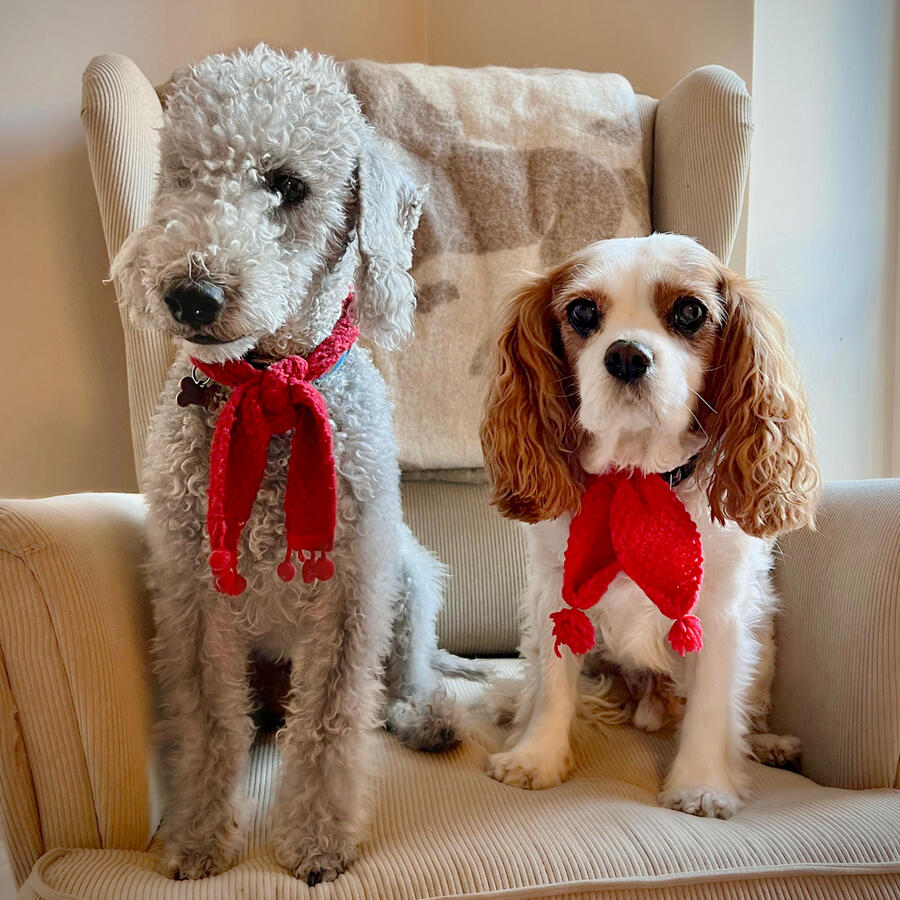
The setter mainly known as Vlad also sets as Tyrus, which sounds classical but is an anagram of Rusty, a childhood dog. Knut (Rob Jacques again) is named after a briefly-viral polar bear cub and is based on his wife likening him to a bear, and another of Rob's aliases is Magnus, his old Great Dane.
Liari mentioned above also sets as Apus and Pavo, constellations that are named after birds (she loves birds, you see). And on birds, Dave Williams chose Skirwingle for the amusingly vague OED definition: 'n. Some kind of bird'.
Places
Sometimes a meaningful place can provide a setter with their name. Eccles mentioned above also sets as Snape, his home village in Yorkshire. Michael Lloyd-Jones sets as Deri, part of his street address, while Dean Mayer is Loroso, which sounds wonderfully Italian but is in fact based on LOndon ROad SOuth.
The aforementioned Rufus also set as Hodge and Bower, the two halves of the street name where he lived. Dan Dickens is Brockwell as his house overlooks the London park of the same name.
Emma chose Heron as it's the emblem of Herne Bay where she lives, and another of her pseudonyms is Turnstone, another bird seen on the beach there.
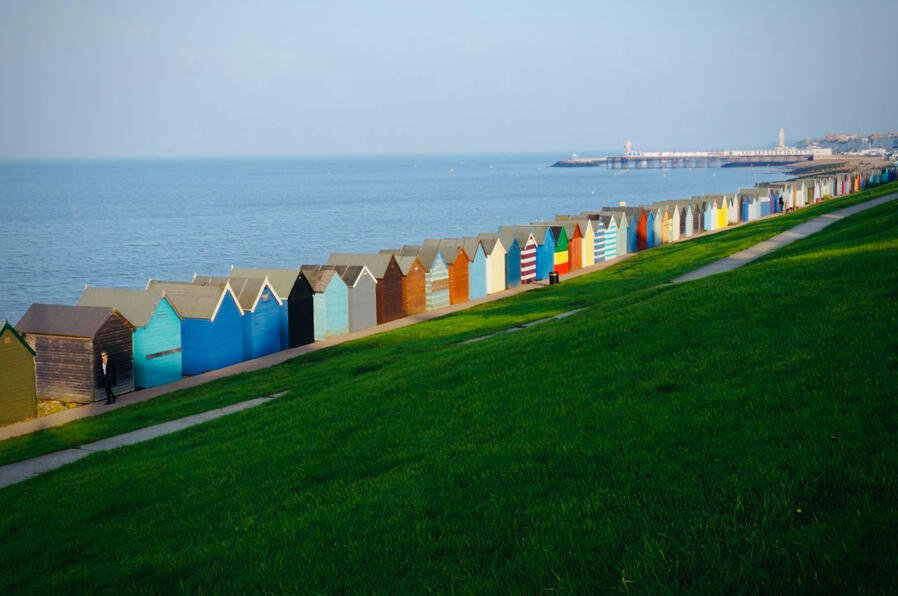
Crucible aka RD Anderson is named after the Sheffield theatre and snooker venue, his first published puzzle being snooker-themed. Ashley Knowles chose Boatman from his 100-foot barge, which he spent 10 years converting. And Tom Johnson came up with Gozo while on holiday on the island.
The art of the crossword
The nature of the crossword itself - setting the challenge and demanding the answers - has inspired quite a few setters: three legendary trailblazers all worked with names of 'Grand Inquisitors': Edward Powys Mathers was Torquemada, followed by Derek Somerset Macnutt as Ximenes, then Jonathan Crowther who reversed Deza to become Azed.
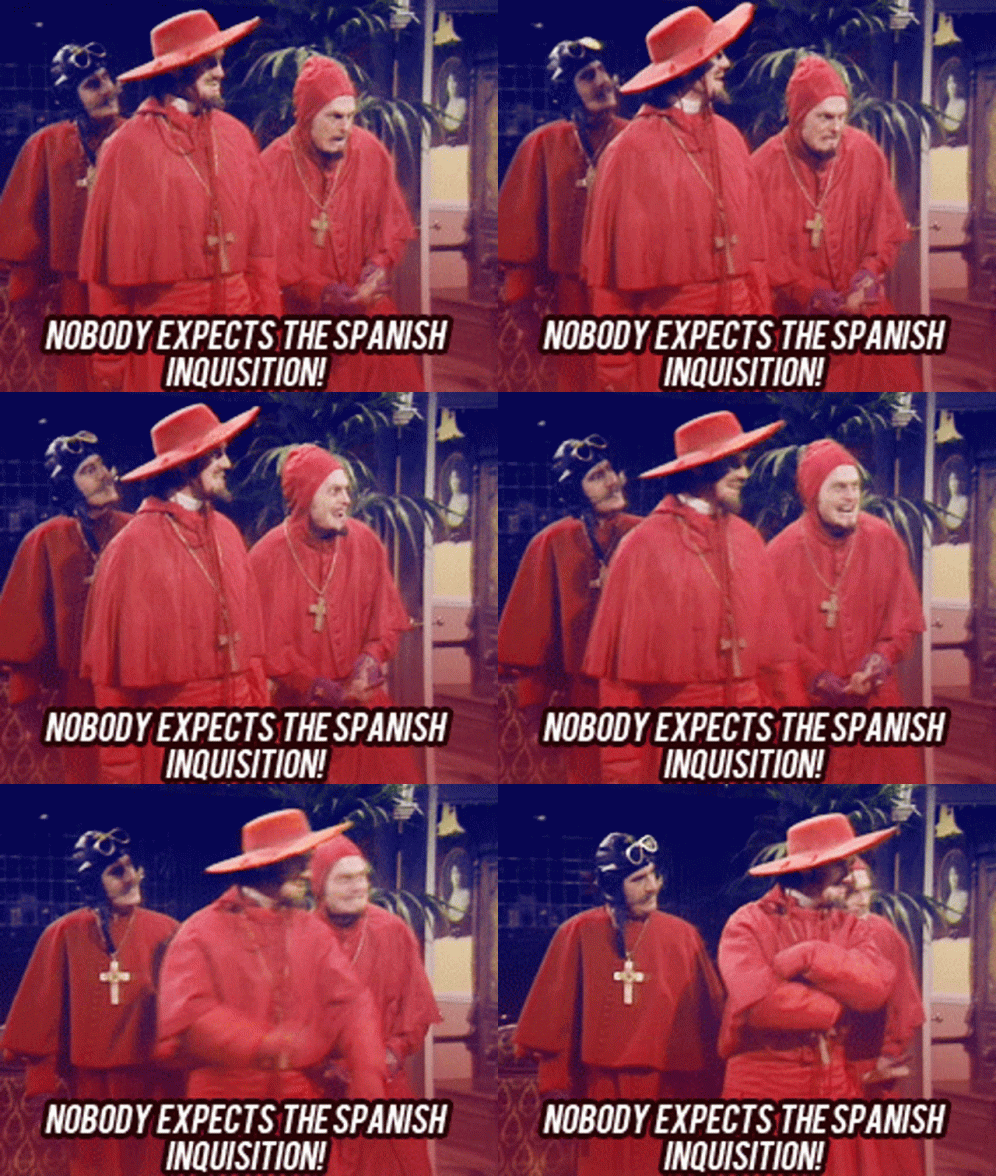
David Moseley chose Gordius of the mythical knot problem. Jim Toal picked Vlad as 'Vlad the Compiler' sounded like a more civilised version of the namesake Impaler. Sarah Hayes aka Arachne says she likes the image of "slightly nervous victims becoming entangled in the web". Paul Facey-Hunter liked Puck for the implication of mischief. And of course Araucaria (John Graham) was named after the monkey-puzzle tree.
Such crossword-inspired names are sometimes a little more self-deprecating, like Dogberry, or John Young, named for the character in Much Ado About Nothing who keeps getting his words mixed up. Others are more subtle, like Paul Bringloe's Tees who at first glance suggests the river but was in fact chosen for its aural proximity to 'tease'.
Saving the best for last
I know this is subjective, but the one pseudonym I encountered in my research that made me properly laugh out loud was that of Christopher Brougham in the Spectator. His pseudonym was Dumpynose, which is of course an anagram of... no - I'll let you work it out! 😆
Your turn
In the comments below, let us know the story behind your setting name...
Sign in to leave a comment
Sign in to leave a comment
Tug is twofold: partly a reference to former MLB pitcher Tug McGraw, and partly self-deprecating to my perpetually single status. It's also a short, blunt word that I could use in a clue, and it leads to innuendo when solving ("time for a quick Tug now"). I haven't set enough to use a second name, but if I do, it'll be Trig (what I used in the new Backyard Baseball release because "Tug" got blocked by the censor bot): keeps the T-g and references my being a math teacher.
Simply just a love of all things Rowan Atkinson!
"Jack" has been my online pseudonym since I was about nine years old, and "bluejacket" is also an archaic word for a type of sailor. Referencing archaic words for sailors felt very apposite for cryptic crossword setting! :D
"Fez" is from a Moroccan proverb along the lines of: "You say you are going to Fez. But I know you are not going to Fez. Then, you *do* go to Fez ... and yet you call yourself my friend?!" "Cranberry" is a shortening of my original 225 name "cranberryboat", derived from my fave album, the Fiery Furnaces' "Blueberry Boat", with a shift to red for (UK) political allegiance. And "Blancheflower" is from one of the album highlights, "Chief Inspector Blancheflower" 🙂
My Dumpynose, Sisyphus, might well have been chosen by any of us. We get up each morning to the outwardly pointless task of getting a crossword boulder to the summit of ‘total solution’. And then we do it again, day after day after day. Of course we pretend we’re enjoying it- but do we actually have any choice? Well I *do* enjoy my addiction, both as solver and setter, mainly driven by the thought that I can always do better; and who knows, baby, one day maybe… I might just become mythological.
In 1998 during the football World Cup I became deeply embedded in the pre-Reddit Wild West that was Yahoo! Message boards. ("Who will win World Cup? I think... Brazil" was the first post of a thread that had nearly 25,000 replies - some of them even about football.) Having recently become a father for the first time, I chose MITB_dad as my user name (those being my daughter's initials) and this very quickly got shortened to Mitz. The rest, as they say, is history.
Guinevere is another one based on actual name - it’s the origin of my given name. Kybos is the Greek for a six-sided die - she’s Dice’s more well-behaved equivalent! I had looked at ‘Alea iacta est’ for inspiration for a pseudonym, but reading in to it, a lot of scholars apparently believe that Caesar probably actually spoke Greek rather than Latin - hence going with the Greek Kybos (pronounced Cube-oss, it’s where our word ‘cube’ originates).
Unlike others, the reason for my name isn't so deep lol. It's just my Reddit username I made in 8th grade. I used to post stories (I was 14 so not the best writing) in r/Ruleshorror referencing a random friendly guy that lives in fridges. Some years passed and I found r/crosswords; I learn to set cryptics through trial-and-error and reading online resources. The name just has a soft spot in my heart (fridges are cool, literally) and I use it because it's fun and reflects my youthfulness!
Mine is a nod to my other hobby :) I took up crossword setting when poker was effectively banned in Tasmania from 2023-2024 (It’s sort of back now but very restricted!) Since then I’ve been setting crosswords as Flush, chosen as both a nod to my card playing alter-ego and as it has multiple meanings that could potentially be woven into clues. I figured if I need another at any point I’d continue to draw from the rich poker lexicon!
Oh, as a footnote: I do have another alias, 'Odo', that I didn't mention as it didn't neatly fit in my arbitrary categorisation 😆 ... the Guardian asked me to come up with a new name for them, and I retrospectively decided that 'Henri' was in fact named for an ancient French king, and so hit Wikipedia in search of others. I was drawn to Odo (888-898) as the only king from the 'Robertian' house -- my real name being Robert, you see... ☺️
For some odd reason, perhaps to bring a measure of order to a highly cryptic TV show, I used to diagram sentences from & about Twin Peaks and then share them via a Twitter (and later YouTube) account called TwinPeaksGrammar (@tpgrammar). When my new cryptic obsession hit, I kept that handle without understanding the crossword pseudonym tradition. Should I one day be published, I'd want to use "and" for a setter name (interplay btw setter & solver; across n down; WP & def; and it's close to Ant).
My name is a light-hearted Asterixification relating to "etymon", meaning root word. There's a loose analogy with setting: we provide the "roots" to the solution. In Ancient Gaul, I imagine Etymonix to be close friends with the dreadful bard Cacafonix: we drink into the small hours and lament how little our Art is appreciated. Two millennia later: google "etymonics, SolveForce" to experience what is perhaps the most bizarre marketing gobbledygook ever written. We're gonna need some Magic Potion.
Simply a palindrome, which I've always loved since discovering "a man a plan.." as a kid. Then when Nada Surf, one of my favourite bands released a covers album called ifihadahifi, it made my day and there was no other choice.
Burrows is a three-way composite. It's primarily a reference to how easily distracted I am - one of my teachers rightly said that I can't walk past a rabbit hole without falling into it. It's also a nod to happy little space bunny, one of my more oblique creations, a trans-dimensional avatar that manifests as a tea-loving Kawaii-style beatnik bunny. The name was coined not long after I'd been discussing the correct title of Naked Lunch, so that may well have had a subliminal input, too.
Burrows is a three-way composite. It's primarily a reference to how easily distracted I am - one of my teachers rightly said that I can't walk past a rabbit hole without falling into it. It's also a nod to happy little space bunny, one of my more oblique creations, a trans-dimensional avatar that manifests as a tea-loving Kawaii-style beatnik bunny. The name was coined not long after I'd been discussing the correct title of Naked Lunch, so that may well have had a subliminal input, too.
Online, I already had a pseudonym, "not without text", which I use in r/crosswords. But I felt it wasn't namey enough for a cryptic pseudonym, so I chose Lastre, which I had used before on PuzzGrid. It started as a joke I made about algorithmic sorts: the "Lastre sort", which frantically asks someone online to sort a list (punning on "last resort"). For a time, I made my display name Lastre, and people started to call me that more, unaware of the joke. I liked it too, so I just went with it.
Mine's from the classic Norwegian saying - There's no such thing as bad weather; only bad clothing. A very optimistic saying, although for me, rainy weather is perfect because it is matched with the perfect clothing of a sweater and blanket, safe inside with a cryptic crossword...
37 comments